TEMPO.CO, Jakarta - Thousands of passengers remained stranded in Indonesia on Monday, September 7, 2026, after volcanic ash from the erupting Mount Anak Krakatau disrupted flight operations across the country, with six airports still closed in the latest update from the Transportation Ministry.
The eruption had affected eight airports, delaying or cancelling 1,558 flights and stranding about 170,000 passengers, according to the Transportation Ministry as reported by Al Jazeera. More than 900 of the disrupted flights involved services to and from Soekarno-Hatta International Airport, Indonesia’s main gateway outside Jakarta.
The ministry initially extended the closure of Soekarno-Hatta, located more than 150 kilometers from Anak Krakatau, until 8:59 a.m. local time on Monday.
By Monday morning, however, the Ministry of Transportation said six airports remained closed due to the impact of volcanic ash. According to Detik.com, Lukman F. Laisa, the ministry’s Director General of Civil Aviation, said the closures had been extended until 8:59 a.m. local time, or 09:00 WIB (Western Indonesian Time).
The six airports are:
1. CGK (Soekarno-Hatta Airport: CLOSED 23:20 – 08:59 WIB)
2. HLP (Halim Perdanakusuma Airport: CLOSED 23:26 – 08:59 WIB)
3. TKG (Radin Inten II Airport in Lampung: CLOSED 23:23 – 08:59 WIB)
4. BDO (Husein Sastranegara Airport in Bandung: CLOSED 23:31 – 08:59 WIB)
5. RTO (Budiarto Airport in Curug: CLOSED 23:29 – 08:59 WIB)
6. PCB (Pondok Cabe Airport: CLOSED 23:36 – 08:59 WIB)
The earlier shutdown had also affected Taufik Kiemas Airport and Atung Bungsu Airport, bringing the total number of affected airports to eight.
Volcanic Ash Spreads Toward Jakarta
The Meteorology, Climatology, and Geophysics Agency (BMKG) reported that volcanic ash from Anak Krakatau had spread toward Lampung and parts of Jakarta.
Based on information from the Center for Volcanology and Geological Hazard Mitigation (PVMBG), the Darwin Volcanic Ash Advisory Center (VAAC), and analysis of Himawari-9 satellite imagery, BMKG identified two clusters of ash dispersion as of 4 a.m. local time on September 6.
The first cluster was moving toward Jakarta, Banten, and West Java, with ash reaching an altitude of 20,000 feet. BMKG said the dispersion extended from the surface to 20,000 feet and was moving in a northeast-to-south direction across parts of Jakarta, Banten, West Java, and surrounding waters.
A second ash dispersion cluster also affected areas around the volcano and neighboring regions.
Volcanic ash presents a major hazard to aircraft because it can damage jet engines and reduce visibility, prompting authorities to suspend flight operations at affected airports.
Alternative Airports Prepared
As reported by Al Jazeera, Transportation Minister Dudy Purwagandhi said several airports, including those in Semarang and Surabaya, had been prepared as alternative landing locations.
The government has also urged airlines and passengers to adjust flight arrangements as airport closures and disruptions continue.
In Jakarta, schools were scheduled to shift to online classes on Monday because of the ash from Anak Krakatau.
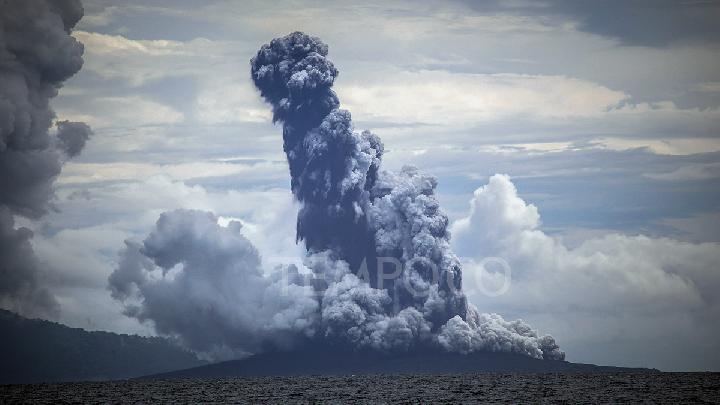
The volcano began erupting late Friday, producing lava fountains and booming sounds that Indonesian authorities said could be heard up to 700 kilometers away.
BMKG reported ash reaching about 6,000 meters, or 20,000 feet, on the Java side of the volcano, while a plume reaching up to 15,000 meters, or 50,000 feet, was observed over the Sumatra side and parts of Banten. Two additional eruptions were recorded on Sunday.
No Immediate Tsunami Risk
Indonesia’s National Disaster Mitigation Agency (BNPB) said there was no imminent tsunami threat from the eruption.
BNPB also announced measures including cloud seeding to encourage rainfall that could wash volcanic ash from affected areas. BNPB chief Suharyanto said heavy rain could help clear the ash that had been disrupting daily activities.
Ships traveling through the Sunda Strait, which separates Java and Sumatra, were also urged to increase vigilance because volcanic activity could affect navigation safety.
Local port authorities prohibited vessels from entering an exclusion zone within a three-kilometer radius of Mount Anak Krakatau.
The volcano emerged from the sea in the 1920s inside the caldera left by the catastrophic 1883 eruption of Krakatoa, one of the deadliest volcanic events in recorded history.
Anak Krakatau has erupted periodically since then. In 2018, a partial collapse of its crater triggered a tsunami that killed more than 400 people along the coasts of Java and Sumatra.
Read: Minister Says Prabowo Monitors Anak Krakatau Impact on Flight Operations
Click here to get the latest news updates from Tempo on Google News