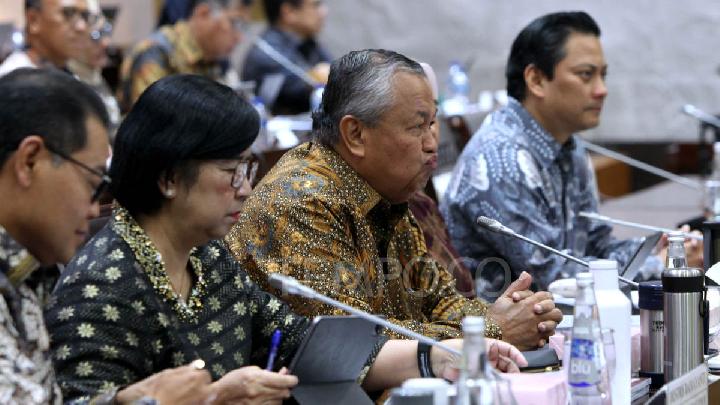
TEMPO.CO, Jakarta - The US Federal Reserve left interest rates unchanged at 3.50%-3.75% on Wednesday, but new Chair Kevin Warsh used his first Federal Open Market Committee (FOMC) meeting to signal what many analysts view as the beginning of a major shift in the central bank's approach to monetary policy.
The decision itself largely matched market expectations, yet a series of changes introduced by Kevin Warsh surprised investors and triggered volatility across financial markets. US stocks declined following the announcement, while Treasury yields moved higher as investors reassessed the outlook for interest rates and the Fed's broader policy framework.
One of the most notable developments was Warsh's decision not to participate in the Federal Reserve's Summary of Economic Projections (SEP), including the closely watched "dot plot" that outlines where policymakers expect interest rates to be in coming years.
As reported by CNBC, Warsh confirmed during his post-meeting press conference that he chose not to submit his own projections, citing longstanding concerns about forward guidance.
"It's been the practice of this committee for participants to submit these projections, and I have encouraged my colleagues to continue to do so," Warsh said. "I, however, have refrained from offering any projections of my own consistent with my long-held views on the SEP, at least as currently structured."
The move broke a 14-year precedent established after former Fed Chair Ben Bernanke introduced the dot plot in 2012 as part of efforts to improve transparency following the global financial crisis.
While some policymakers have previously declined to provide certain long-term projections, Warsh became the first Fed chair to abstain entirely from the forecasting exercise.
According to The Motley Fool, Warsh has long criticized the Fed's reliance on forward guidance, arguing that financial markets should focus on incoming economic data rather than attempting to predict how policymakers might react.
"I think financial markets perform best when they react to incoming data," Warsh said. "I think financial markets work less efficiently when they ask the question, 'How will the Federal Reserve react to that incoming information?'"
Although the Fed left rates unchanged, the dot plot released by other committee members suggested policymakers remain concerned about inflation. The FOMC was evenly split between officials expecting stable rates or a cut and those anticipating at least one rate increase, with the median projection pointing toward a quarter-point hike later this year.
Warsh's emphasis on inflation also stood out during the press conference. Observers noted that he repeatedly stressed the importance of maintaining price stability, a tone many interpreted as more hawkish than expected from a chairman who had previously spoken favorably about lower rates.
The market reaction reflected those concerns, with the policy-sensitive two-year Treasury yield rising sharply after the meeting.
Beyond interest rates, Warsh announced a sweeping internal review of the central bank through the creation of five new policy task forces. The groups will examine Fed communications, balance sheet policy, data collection practices, productivity and labor-market changes, the impact of artificial intelligence and emerging technologies, and the institution's inflation framework.
The initiative signals that Warsh intends to reassess nearly every major component of the Fed's policymaking process.
Several market analysts described the move as evidence that the central bank is entering a period of significant transformation.
"Today we believe that the Federal Reserve's FOMC ushered in a new era of monetary policy in the United States," Rick Rieder, head of fixed income at BlackRock, said after the meeting.
Others pointed to the breadth of the review as evidence that Warsh intends to leave a lasting mark on the institution.
Jason Pride, chief investment strategist at Glenmede, said the task force announcements indicate "an institution in active review rather than steady state," adding that investors should expect the Fed's operating framework to look substantially different during Warsh's tenure.
Warsh's focus on reform was also visible in a more symbolic change: the length of the Fed's policy statement. Previous statements often exceeded 300 words and contained language closely scrutinized by investors for policy clues. Wednesday's statement was only 130 words long.
The shorter format aligns with Warsh's broader push to simplify communication and reduce what he sees as excessive market dependence on central bank signaling.
His first meeting as chairperson therefore offered a glimpse into what may become defining features of his leadership: less forward guidance, stronger emphasis on inflation control, streamlined communication, and a willingness to revisit long-standing Fed practices.
Whether those changes ultimately reshape monetary policy remains uncertain. But after only one meeting, Kevin Warsh has already made clear that the Federal Reserve under his leadership will not operate exactly as it did under his predecessors.
Read: Kevin Warsh Net Worth 2026: A Look at Trump's Fed Pick
Click here to get the latest news updates from Tempo on Google News