
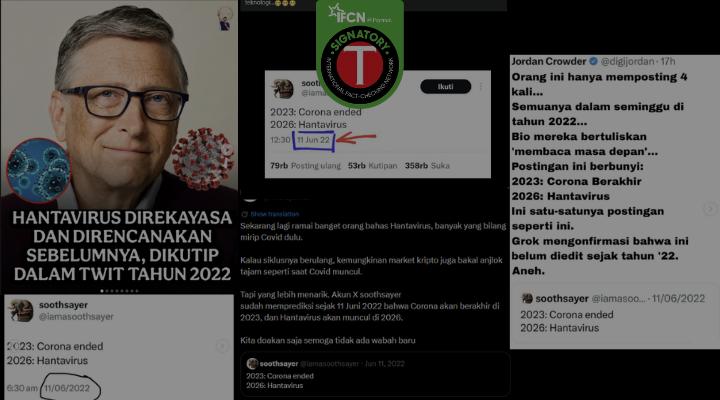
TEMPO.CO, Jakarta - A number of accounts on Instagram [archive], Facebook, and X have linked the emergence of the Hantavirus in 2026 to a prediction by the Soothsayer account on X social media from 2022. The account wrote that the Coronavirus would end in 2023 and that the Hantavirus would emerge in 2026.
The tweet, "2023 Corona ends, 2026 Hantavirus," suddenly went viral in May 2026, being shared 150,000 times.
But was it true that the Hantavirus had been predicted in 2022 as a replacement for the Covid-19 pandemic?
FACT CHECK
Tempo verified the narrative by tracing the original post and comparing it with credible information. The results showed that although the Soothsayer account's tweet was true, the Hantavirus had actually been identified long ago and had been endemic since the 1950s.
Further research on platform X revealed that Soothsayer's old posts were still publicly accessible. The account, which lists its location in the Philippines, was created in June 2022, right in the midst of the global COVID-19 pandemic.
Tempo has reached out to the account owner via platform X for confirmation but has not received a response as of the publication of this article.
Hantavirus Was an Outbreak in the 1950s
The tweet from the Soothsayer account is circulating without complete historical context. In fact, the Hantavirus is not a new commodity but rather an old threat that has triggered major outbreaks in South Korea since the 1950s.
Research by Kansas University Medical Center researcher Mohammed A. Mir, published in his 2010 article "Hantaviruses," revealed that an outbreak of Hemorrhagic Fever with Renal Syndrome (HFRS) affected more than 3,000 UN troops during the Korean War from 1951 to 1953. This series of deadly cases prompted scientists to trace the disease's origins.
In 1978, researchers successfully isolated the virus that caused the fever from infected rats around the Hantan River in South Korea. This discovery was later named Hantaanvirus after the river, before being classified in a new genus called Hantavirus in 1981.
This virus resurfaced in the western United States in 1993 with an outbreak of Hantavirus Pulmonary Syndrome (HPS), which infected at least 53 people in 14 states.
National Institutes of Health (NIH) data, as reported by the BBC, estimates that there are approximately 150,000 cases of HFRS worldwide each year. The majority of cases are spread across Europe and Asia, with the largest number found in China. Meanwhile, in the United States, health authorities recorded 890 cases of infection between 1993 and 2023.
Differences in Characteristics of Hantavirus and Covid-19
The US Centers for Disease Control and Prevention (CDC) summarizes the fundamental differences between Covid-19 and the Hantavirus that causes Hantavirus Pulmonary Syndrome (HPS). Historically, Covid-19 was only identified in 2019 in Wuhan, China. In contrast, Hantavirus outbreaks have been traced since the 1950s in South Korea before being isolated and recognized in 1978.
The transmission patterns and biological structures of these two viruses are also different. Covid-19 spreads through respiratory droplets. Meanwhile, humans contract HPS by inhaling air or dust contaminated with the feces, urine, or saliva of rats carrying the virus.
Al Jazeera reports that this difference in transmissibility is influenced by the physical structure of each virus. COVID-19 has crown-shaped protein spikes that allow it to spread rapidly. Hantavirus, on the other hand, is enveloped in a lattice-like glycoprotein structure, making its transmission rate much lower.
The incubation period and mortality rates of these two diseases are also different. COVID-19 has an incubation period of 2 to 14 days, while HPS requires 7 to 20 days. This longer incubation period for HPS actually reduces the potential for widespread transmission.
Despite both being fatal, the WHO recorded a COVID-19 mortality rate of 3.4 percent in 2020. The mortality rate for HPS ranged from less than 1 to 15 percent in Asia and Europe, and could soar to 50 percent in the Americas, although cases are very rare.
CONCLUSION
Tempo concluded that the narrative claiming a Hantavirus outbreak will trigger a pandemic in 2026 similar to COVID-19 is misleading.
**Do you have information or claims that you want to have fact-checked? Contact our ChatBot. You can also send criticism, objections, or feedback for this Fact-Checking article via email to [email protected].
Fact Check: No, The Simpsons Did Not Predict the Hantavirus Outbreak
1 hari lalu

Fact check - The circulating image has been modified using artificial intelligence.
Fact Check: Did X-Files Predict the Hantavirus Outbreak?
2 hari lalu

Fact check - The deaths in science fiction film The X-Files: Fight the Future were caused by a fictional alien virus, not Hanta virus.
Fact Check: Is Andes Hantavirus Really a New Virus?
3 hari lalu

Fact check - Long before the cruise ship MV Hondius outbreak, the Andes strain of hantavirus had caused outbreaks in Argentina in 1996 & 2018.
Fact Check: Moderna's 2023 Vaccine Research Does Not Prove Hantavirus Was Engineered for Profit
4 hari lalu

Fact check -The vaccine was pioneered by S. Korea, while collaboration between Korea University & Moderna since 2023 has only been mRNA-based R&D.
Fact Check: Hantavirus Is Not a Covid-like Conspiracy
4 hari lalu

A Tempo fact check debunks social media claims that the Hantavirus is a laboratory-engineered conspiracy or an agenda for vaccine commercialization.
Fact Check: Hantavirus Outbreak Wasn't a Cover-Up for Disney Crew Child Porn Case
6 hari lalu

An Instagram claim on May 10, 2026, alleged the Hantavirus was meant to divert attention from a Disney employee child pornography case.
Fact Check: Hantavirus Was Not Planned by Jeffrey Epstein
6 hari lalu

Fact check - Hantavirus was first discovered in the 1950s during the Korean war, while Jeffrey Epstein was born in 1953.
Fact Check: WHO Never Linked Hantavirus to Child Vaccination
8 hari lalu

Tempo's fact check team's verification reveals that the WHO never claimed the Hantavirus is being used to promote mass childhood vaccination.
Fact Check: Hantavirus Is Not a Second COVID-19 Pandemic
9 hari lalu

Fact check - Hantavirus is different from COVID-19 so it is not a second pandemic.
Fact Check: Virus Outbreaks Do Not Occur Every 6 Years
10 hari lalu

Fact check - There is no 6-year virus outbreak pattern in epidemiology.