August 11, 2026 | 07:32 am

TEMPO.CO, Jakarta - Nur Hidayah, an economist at the Center for Sharia Economic Development (CSED) of the Institute for Development of Economics and Finance (INDEF), projects that Indonesia's sharia financial industry assets will grow by 8 to 11 percent by 2026. According to her, the outlook for the sharia financial industry remains positive this year, even though its growth continues to face a number of structural issues.
"A figure of Rp3,131 trillion with 8.56 percent growth is indeed a record. However, a record set by an industry growing from a small base is not an extraordinary achievement," Nur told Tempo on Monday, August 10, 2026.
Previously, the Financial Services Authority (OJK) reported that the total assets of the national sharia finance industry reached IDR 3,131.02 trillion in 2025. This figure represents an 8.56 percent year-on-year (yoy) increase and marks the highest level since the sharia finance industry began developing in Indonesia. This achievement is detailed in the 2025 Indonesian Sharia Finance Development Report (LPKSI) published by the OJK.
Nur explained that this asset achievement must be viewed in terms of growth sources and market share development, rather than just nominal value. If the growth of sharia financial assets merely matches or slightly exceeds that of national financial assets overall, the sharia industry's market share is considered to have remained largely unchanged, despite having developed over approximately three decades. Therefore, growth must be accompanied by improvements in market share, quality, efficiency, and competitiveness.
According to Nur, three issues affect the prospects of the sharia finance industry in 2025. First is the reliance on the state, as a significant portion of assets lies within the sharia capital market, with sovereign sukuk (Islamic bonds) serving as a dominant instrument. Second is the concentration of players in the sharia banking industry, which can limit competition, innovation, and efficiency. Third is the separation of sharia business units from their parent banks, a process that could expose issues regarding capitalization, customer bases, liquidity, and the cost of funds. This process is expected to drive further consolidation, which is considered healthy in the long run.
On the other hand, Nur identified the Muslim population and the growth of the middle class as key potential drivers for the sharia finance industry, even though this potential has not yet fully translated into demand. Regulatory strengthening through the Law on the Development and Strengthening of the Financial Sector (P2SK), improved governance, and coordination with the National Committee for Sharia Economics and Finance (KNEKS) are also seen as providing certainty for the industry. Islamic social finance—such as zakat, cash waqf (endowment), and cash waqf-linked sukuk—along with digitalization, are viewed as potential sources of growth and industry differentiators.
Nur also highlighted the issue of product differentiation. Sharia banking financing remains dominated by sale-and-purchase contracts—particularly murabahah—while profit-sharing contracts such as mudharabah and musyarakah account for a smaller share. Furthermore, a low proportion of low-cost funds renders Sharia banks' cost of funds less competitive; this results in higher financing margins and limits their ability to attract corporate and prime clients.
Other challenges include Sharia compliance governance, a shortage of human resources proficient in both fiqh (Islamic jurisprudence) and modern finance, and gaps in financial literacy and inclusion. According to Nur, the fact that inclusion levels exceed literacy levels suggests that some members of the public utilize Sharia financial products without fully grasping their underlying principles. Additionally, the halal industry and Sharia finance ecosystems remain unintegrated, even though their interconnection could bolster financing for productive sectors and serve as a defining characteristic of the industry's development in Indonesia.
Nur believes that asset growth should not be the sole metric for measuring the success of the Sharia finance industry. Other crucial indicators include the capacity to finance productive sectors, reach micro-enterprises and underserved groups, and contribute to reducing inequality. Consequently, the achievement of Rp3,131 trillion in assets—reflecting 8.56 percent growth—should serve as a momentum to evaluate the quality and trajectory of the industry's growth.
Dian Ediana Rae, the OJK’s Chief Executive of Banking Supervision and Chair of the Sharia Finance Development Committee (KPKS), stated that the OJK would continue to oversee the development of the Sharia finance industry through the implementation of various regulations, sectoral roadmaps, and policies designed to strengthen the industry's competitiveness.
Read: OJK Says Indonesia's Sharia Banking Industry Still Lacks Competitiveness
Click here to get the latest news updates from Tempo on Google News
OJK Says Indonesia's Sharia Banking Industry Still Lacks Competitiveness
27 November 2023

OJK Chief Executive of Banking Supervision Dian Ediana Rae explained that the sharia banking industry is still relatively small.
Indonesia Islamic Finance Assets Hit Rp2,375tn, OJK Says
16 Februari 2023

Indonesia's Financial Services Authority (OJK) says the assets of the country's Islamic finance amounted to Rp2,375.84 trillion as of December 2022.
NU Education Plays Significant Role in Sharia Economy Development: Sri Mulyani
12 Maret 2021

Finance Minister Sri Mulyani says Nahdlatul Ulama (NU) has successfully combined Islamic and Indonesian values in harmony.
Ma'ruf Amin Talks of Great Challenges of Developing Sharia Economy
12 Maret 2021

VP Ma'ruf Amin revealed three challenges for Indonesia to develop Islamic economic and financial products that are competitive in the global market.
Ma'ruf Amin on 8% Growth of Indonesia Sharia Economy: Not Optimal Yet
4 Maret 2021
Vice President Ma'ruf Amin stated that Indonesia's sharia economy has just developed by 7 to 8 percent from its existing potential thus far.
Jokowi: Potential Cash Waqf Can Reach Rp188 trillions
25 Januari 2021

President Jokowi today along with Vice President Ma'ruf Amin and Finance Minister Sri Mulyani launched the National Cash Waqf Movement (GNWU).
Halal Industry; Jokowi Calls For Improvement of Ecosystem, Regulation, and HR
28 Oktober 2020

President Jokowi lamented the great potential of Indonesia's halal industry that has not been fully exploited.
Ma'ruf Amin: Govt Preps Economic Recovery of Sharia Finance
9 Juni 2020
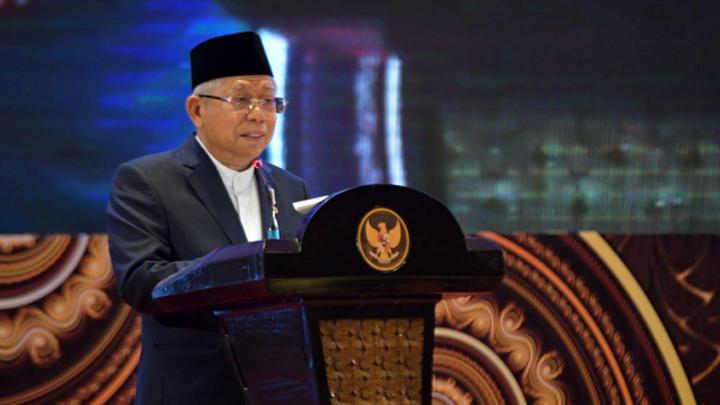
VP Ma'ruf Amin stated on Tuesday that the government was preparing a policy scheme on the economic recovery and sharia finance affected by Covid-19.
OJK Gives Foreign Investors Leniency to Acquire Sharia Banks
19 Juni 2015

The regulator is providing lenient terms for foreign
investors planning to enter Indonesia's sharia banking
sector.
OJK Calls on Sharia Industry to Grease Economy
1 Juni 2015

The sharia financial services industry is expected to take on
a greater role in national development, OJK deputy says.