
TEMPO.CO, Jakarta – The astronauts on the Artemis II mission made history on Monday, reaching the farthest distance in space of any human, after surpassing the previous record set by the Apollo 13 mission in April 1970.
With just an hour before kicking off the fly-around and lunar observations, the spaceship was flying at 252,752 miles (406,764.9 kilometers), surpassing the distance record of 248,655 miles set by Apollo 13.
The Orion capsule had earlier on Monday reached the moon's gravitational sphere, meaning the spacecraft was more strongly affected by the moon's gravity than Earth's, NASA said.
In the next few hours, the spacecraft is expected to come closest to the moon, about 7,500 kilometres beyond the far side.
The flight trajectory of the Artemis 2 flight resembles a figure of eight around Earth and the moon.
Why is the Artemis II mission historic?
When the spacecraft comes closest to the moon, the astronauts will be able to see Earth and the moon at the same time — and even a solar eclipse in which the Sun disappears behind the moon from Orion's perspective.
The astronauts entered what NASA calls the lunar sphere of influence at 0442 GMT Monday and will soon record the first lunar flyby since 1972, during which the crew will travel farther from our home planet than any human before.
This is the first time in more than 50 years that a crew, consisting of US astronauts Victor Glover, Christina Koch and Reid Wiseman and Canadian astronaut Jeremy Hansen, is traveling to the moon.
Victor Glover will become the first person of color to ever fly around the moon, and Christina Koch will be the first woman.
What have the astronauts observed so far?
The astronauts are tasked with documenting the moon during the lunar flyby.
They have already started seeing features of the moon never before viewed with a naked human eye.
In the early hours of Sunday, NASA published an image taken by the Artemis crew that showed a distant moon with the Orientale basin visible.
"This mission marks the first time the entire basin has been seen with human eyes," the US space agency said.
Read: Artemis II: Orion Crew Set to Break Deep Space Record
Click here to get the latest news updates from Tempo on Google News
NASA to Build Moon Base With $20 Billion Investment
12 hari lalu
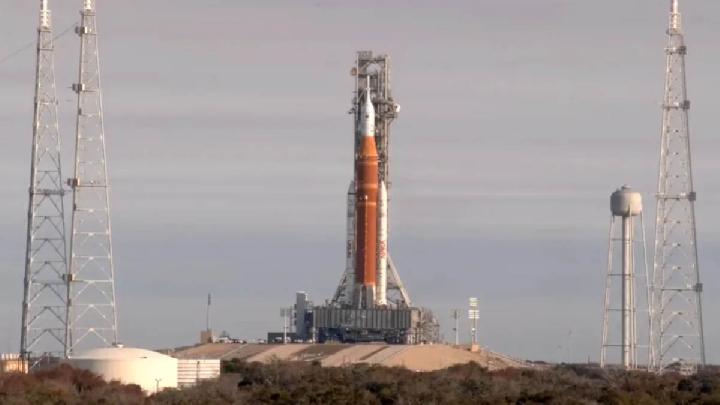
The United States' space agency NASA has announced a $20 billion investment plan over the next seven years to build a base on the moon, while delaying the previously designed space station orbiting the moon.
NASA Continues Preparations for Artemis II Mission to the Moon Amid US Federal Gov't Shutdown
3 November 2025

So far, NASA's crucial operation continues, but officials and contractors warn that its impact could soon be significant.
NASA Leverages Virtual Reality for Moon Mission Training
13 Maret 2025

Simulation using real data from the surface of the Moon collected by NASA's Lunar Reconnaissance Orbiter.
NASA's Next-generation Artemis Mission Heads to Moon on Debut Test Flight
16 November 2022
NASA's towering next-generation moon rocket blasted off from Florida early on Wednesday, Nov. 16, on its debut flight.
NASA Calls Off Artemis Moon Rocket Launch for Second Time in 5 Days
3 September 2022
NASA is aiming to land astronauts back on the moon, including the first woman to set foot on the lunar surface, as early as 2025.
NASA Unveils Landing Sites for Manned Moon Mission
20 Agustus 2022
NASA has selected 13 possible regions at the South Pole of the Moon as potential future landing sites for its Artemis III mission in 2025.