December 23, 2025 | 04:05 pm
TEMPO.CO, Jakarta - Researchers in Japan have developed plant-based plastic that can completely dissolve in seawater within hours, leaving no microplastics behind. This material is designed to be strong enough to serve as packaging while safely degrading if it enters the marine environment.
The plastic is made from the most abundant natural polymer on Earth and was developed by a team led by Takuzo Aida at the Center for Emergent Matter Science (CEMS). CEMS is a research center under RIKEN, Japan's largest national research institution. Published in the Journal of the American Chemical Society, the research offers a new approach to plastics.
Scientists highlighted the material's behavior after it is released into the environment. "This study shows that our work is now at a more practical stage," said Aida, quoted from Earth, Monday, December 22, 2025.
Conventional plastics do not truly disappear; rather, they degrade into microplastics due to exposure to sunlight and ocean waves. These small particles can mix with sand and surface water, be ingested by fish and shellfish, and ultimately end up being consumed by humans. The presence of microplastics is also difficult to track as it requires complex laboratory analysis methods.
In the development, the research team used carboxymethyl cellulose, a derivative of cellulose that is water-soluble and has been produced on an industrial scale. To transform it into plastic, the researchers applied ionic polymerization in water at room temperature. A positively charged polymer then binds to the negatively charged cellulose chain, forming a tight cross-linked network that provides strength and rigidity to the transparent film.
The Secret of Salt Bridges
The strength of this material comes from "salt bridges," which are temporary bonds between opposite electrical charges. When seawater enters, sodium and chloride ions disrupt these bonds, causing the polymer network to disintegrate into components that are soluble in water. To prevent rapid degradation during use, the researchers added a thin protective layer that slows down the entry of water and salt.
The initial version of the material was deemed strong but brittle. To improve flexibility, the team added choline chloride as a "plasticizer" to make the polymer chains more flexible. The flexibility of the material can be customized by adjusting the amount of additives. In a tensile test, the innovative plastic Carboxymethyl Cellulose Supramolecular Plastic (CMCSP) stretched up to 130 percent of its original length before breaking.
The researchers also produced a transparent film measuring 0.07 millimeters thick and processed it into lightweight plastic bags for fruits and vegetables. In a demonstration, the bags were able to hold tomatoes, demonstrating the potential for practical use as thin packaging that is often a source of plastic pollution in water bodies.
The main advantage of CMCSP lies in its disassociation mechanism, where the material degrades into separate molecules instead of small fragments, preventing the formation of microplastics. The soluble components can also be collected and recombined, making this material potentially recyclable in a closed-loop system.
Decomposition Not a Waste Management Solution
Researchers emphasize that rapid degradation in the sea is not the primary solution to plastic waste management. Collection and recycling systems are still necessary to prevent the spread and loss of value of the dissolved material.
Scaling up the production of CMCSP is said to require a stable supply of materials, consistent film performance, and disposal regulations that align with community habits.
Read: Indonesia Uses IAEA NUTEC Program to Monitor Microplastics in Oceans
Click here to get the latest news updates from Tempo on Google News
From Tea Bags to Table Lamps: Surabaya Student Innovates Eco-Friendly Home Dcor
13 hari lalu
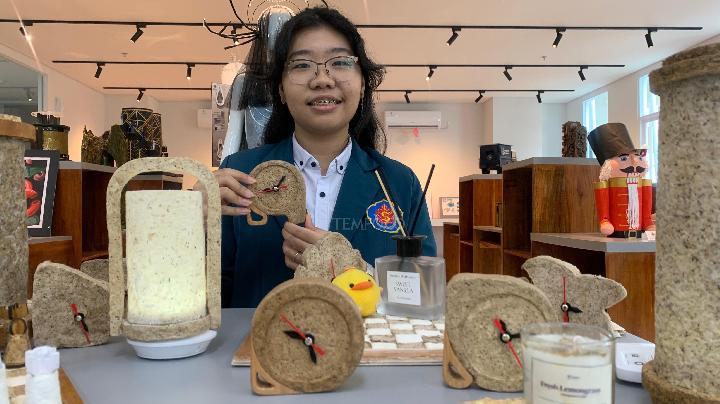
Jeanne Theresia Mintarja, a student at the University of Surabaya, creates home decorations from used tea bags in response to the concerns about microplastic content in tea bags.
Why Does Ocean Plastic Take Decades to Break Down? Scientists Explain
54 hari lalu

Contrary to common belief, most large ocean plastics degrade very slowly at the surface, with about 10 percent still afloat even after a century.
Australia Invests Rp13 Billion to Help Reduce Indonesia's Plastic Waste
55 hari lalu
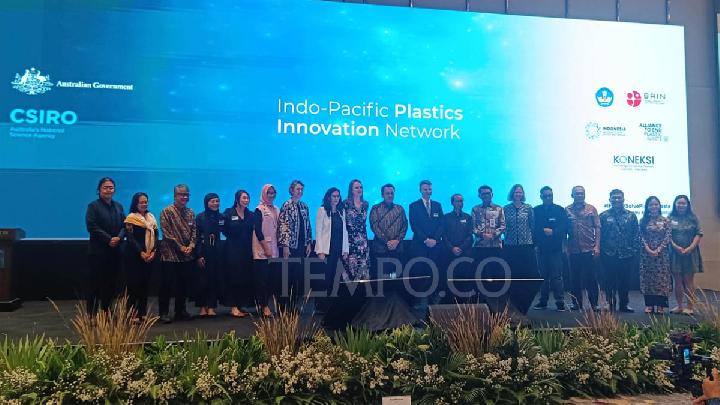
Australia, through the IPPIN program, has allocated approximately Rp13 billion for innovative plastic waste reduction in Indonesia.
GGGI, ADUPI Ink Partnership on Sustainable Plastic Management in Jakarta Summit
15 Agustus 2025

Plastic waste made up 19.75 percent of Indonesia's total waste in 2024, amounting to 6.76 million tons.
UN Talks on Plastic Pollution Fail to Reach Deal
15 Agustus 2025

Negotiations aimed at tackling plastic pollution have concluded without an agreement. Countries differed on how ambitious the treaty should be.
Indonesia's Microplastic Consumption is the Highest in the World, Here's Why
30 Juli 2025
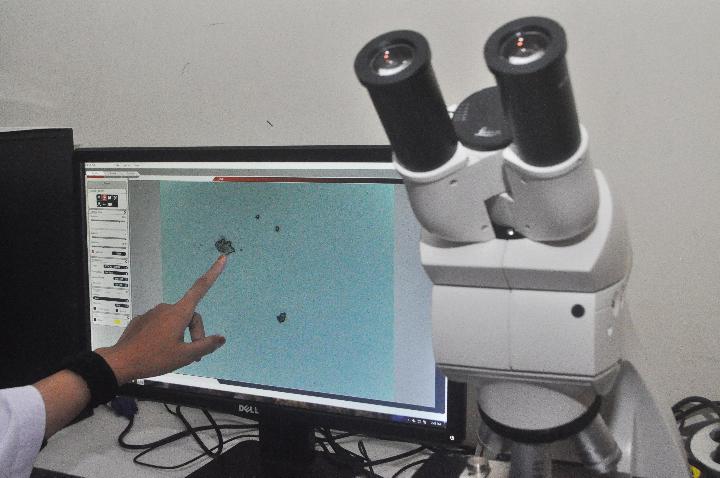
The Nexus 3 Foundation says that Indonesia is the country with the highest microplastic waste production from food waste.
Ecoton Research Finds Microplastics in Drinking Water and River Fish in East Java
2 Juli 2025

Ecoton's findings in various regions of East Java revealed that microplastics are now found in drinking water, river fish, and sediment deposits.
The Silent Threat of Microplastics, Risk of Hormone Disruption
12 Juni 2025

Due to the durability of these tiny plastic particles, microplastics persist in the environment and have been found in a variety of foods.
Why You Should Avoid Wrapping Your Luggage in Plastic
7 Mei 2025

Some passengers may think their luggage is safe in a plastic-wrapped
UNAIR Professor Suggests This Solution to Overcome Microplastics Impact
28 April 2025

With the abundance of microplastics in the waters, people are advised to reduce their consumption of boiled seafood. It is recommended that these food items should be fried instead.